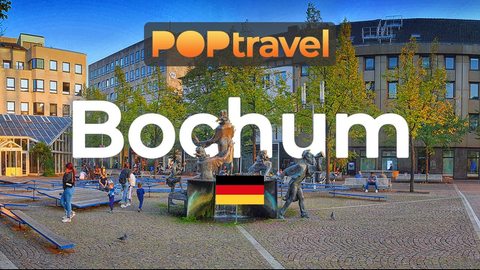
Bochum, Germany
Bochum sits in the Ruhr region with roughly 365,000 residents, making it the second-largest city in Westphalia. From 1842 it served as a coal and steel centre until the Zeche Hannover colliery closed in 1973. Today the 1902 Jahrhunderthalle anchors the Landschaftspark West, opened in 2007, while the 1930 Deutsches Bergbau-Museum ranks as the world's largest mining museum, crowned by a 71-metre winding tower. The 1972 Ruhr-Universität Bochum became the first new university in postwar West Germany, and the Bochum Symphony, founded in 1960, earned renown through the cabaret of Heinrich Pachl.
1 video.